Polycarbonate (PC) is a common choice because it combines impact resistance, clarity, forming flexibility, and printability. But the base film is only one variable. Hard coats, inks, adhesives, thickness, and cutting tolerances decide whether the finished overlay survives its environment.
This guide covers PC properties, how it compares with PET and acrylic, screen and digital printing, artwork requirements, and the specifications to confirm before you order.
Key Takeaways
- Choose PC by the exposure it will face: impact, chemicals, abrasion, UV, heat, flexing, and cleaning.
- Screen and digital printing solve different problems; run size, color needs, and variable data decide.
- Hard coat, adhesive, thickness, and cutout tolerances matter as much as the film.
- Prototype and test under real cleaning and environmental conditions before full production.
What Is a Polycarbonate Graphic Overlay?
A graphic overlay is a decorative or informative design printed on thin material and attached to a product. Butler Technologies describes a membrane-switch overlay as the top printed layer that shows users where to press. The overlay itself carries no circuitry.
A polycarbonate (PC) overlay can combine:
- Text, logos, symbols, and color fields
- Clear windows for displays or indicator lights
- Embossed or raised key areas
- Backlit graphics
- Adhesive backing for mounting
Film versus sheet
Flexible PC film and rigid PC sheet are different products. Tekra lists LEXAN 8B35 matte film in 3-20 mil, while Covestro describes Makrofol SR 622 as acrylic-capped PC sheet. Suppliers draw the film/sheet boundary differently, so tell your printer the application before asking for a material or price recommendation.
Material Considerations for Polycarbonate Graphic Overlays
Material performance in demanding environments
Evaluate impact, abrasion, chemicals, temperature, moisture, UV, and cleaning against the real operating environment. Then check manufacturer data, because published numbers are grade-specific.
- LEXAN 8020 film datasheet (August 2024): Gardner impact of 23 ft-lb at 0.030 in, and heat-deflection temperature of 290°F. That is a film result, not a rating for a finished overlay.
- Tekra's Marnot XL hardcoated PC passes 1-hour and 4-hour contact with acetone, MEK, toluene, and isopropyl alcohol at 73°F (23°C). Concentrated hydrochloric acid passes at 1 hour and fails at 4.
Base film, hard coat, ink, protective layer, and adhesive each change resistance to chemicals, scratching, fading, and wear. Tekra also notes that hard coating protects against intermittent front-surface exposure, while edges, prolonged contact, or permeation stay vulnerable. Some second-surface inks can contribute to chemical stress cracking.

Optical, tactile, and finish requirements
Finish changes both readability and feel.
- Gloss: sharp color, but more glare
- Matte or velvet: cuts glare; Tekra says LEXAN 8B35's texture reduces visible handling scratches
- Clear or translucent windows: for displays and backlighting
- Opaque areas: blocking light where it should not show
Embossing and raised buttons give tactile feedback on control interfaces. Review forming and flexing conditions before production. Per Tekra, embossing can cut PC flex life to below 100,000 actuations, depending on emboss shape and switch travel.
Thickness, hard coats, and adhesive selection
Pick thickness based on flexibility, support surface, cutouts, embossing, handling, and mounting. A membrane-switch overlay usually needs a thinner, more flexible film than a flat nameplate. Hardcoated gauges such as Marnot XL come in 7, 10, 15, 20, and 30 mil.
Adhesive depends on the mating surface, texture, temperature range, moisture, permanence, and service life. Surface energy matters most:
- 3M 467MP suits metals and high-surface-energy plastics.
- 3M 9472LE suits low-surface-energy plastics such as polypropylene and powder-coated surfaces.
Neither adhesive promises an installed lifespan. Storage life (24 months) is not service life.
Polycarbonate compared with other materials
| Attribute | Polycarbonate | Polyester (PET) | Acrylic |
|---|---|---|---|
| Impact | Higher than acrylic | No matched overlay benchmark | Lower than PC |
| Chemicals | Bare PC weaker than PET; coatings help | Better than PC | Resists many dilute acids and alkalis, not ketones or esters |
| Scratch | HB pencil; coating changes results | Slightly harder than PC, still needs hard coat | 5H pencil |
| Embossed flexing | Fatigue-sensitive | Stronger published figures | No benchmark |
| Light transmission | Grade-dependent | No matched figure | 92% (colorless PLEXIGLAS) |
There's no universal best material. PET often suits high-flex or chemically harsh jobs. Acrylic or rigid sheet fits display and stiffness needs. PC fits where impact toughness and formability lead.
Compliance and application-specific requirements
Verify requirements with your material and ink suppliers:
- UL 969 covers permanence and legibility of marking systems, evaluated as a full construction. It is not blanket approval of PC film.
- UL 94 flammability ratings are grade- and thickness-specific. Covestro lists Makrofol FR 344 as V-0 at 10 mil.
- IP and NEMA 250 classify enclosures, not overlay films.
- ANSI Z535.4 governs safety-label design and placement.
Printing Considerations for Polycarbonate Overlays
Screen printing on polycarbonate
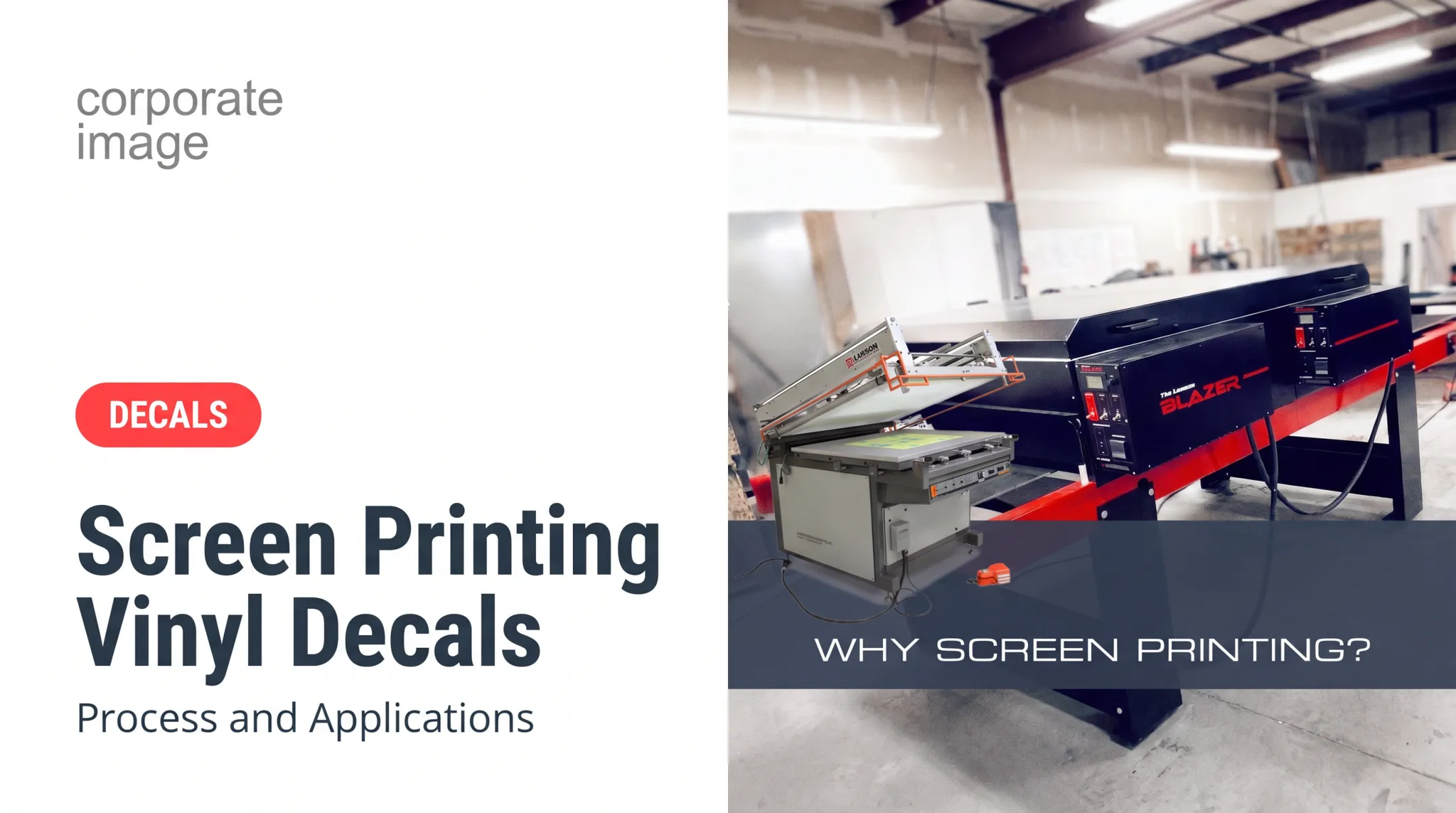
Screen printing pushes ink through a stencil-bearing mesh with a squeegee. It handles repeatable spot colors, opaque layers, fine text, and white underprinting.
Unit costs drop as quantities rise, and ink is mixed to match exact colors. Screen printing can also lay down far more ink than digital, which supports durability.
Match the ink system to the surface and confirm curing:
- Nazdar 2400 UV-LED ink targets second-surface PC/PET overlays and needs 24 hours post-cure before die cutting, embossing, or lamination.
- Marabu MaraSwitch MSW is overprintable in 5-10 minutes at 68°F (20°C), and residual solvent must clear before adhesive goes on.
Test adhesion, chemical and abrasion resistance, and color consistency on production-representative samples.
Digital printing on polycarbonate
Digital printing suits:
- Prototypes and short runs
- Gradients and photographic art
- Versioned artwork
- Variable data such as serial numbers and barcodes
Pricing stays flat whether you print 10 or 10,000, and setup costs are low. Color relies on printer profiles, so matches may only come close.
Durability varies by printer, ink, substrate preparation, protective coating, and environment. Tekra documents hardcoated PC with print-receptive coatings for UV inkjet or HP Indigo, but that does not prove equal performance from every digital system.

Reverse printing and layer construction
Reverse printing puts the graphic on the back of a clear or translucent film, so the polycarbonate protects it. Backlit dead-front panels often use this method.
Layer order drives results. Opaque white, translucent inks, blackout layers, and clear windows each affect legibility, light transmission, and color. Marabu offers a blockout silver for full light blocking, but no universal layer stack fits every product.
Color management and artwork preparation
Settle these before proofing:
- Approved color references and spot versus process color
- Bleed, knockouts, and registration
- Minimum line weights and small text
- Image resolution and transparent elements
- Fonts converted to outlines and logo files
Request a physical proof when brand colors, backlighting, small text, or multiple layers matter.
Finishing and secondary operations
Finishing steps affect each other, so match them to thickness, tolerances, mounting surface, and assembly process. Common operations include:
- Die cutting, digital cutting, and routing
- Holes and radiused corners
- Embossing
- Lamination and protective coatings
Liquid UV clear coat on screen-printed work is a permanent layer applied faster and cheaper than solid laminate on long runs.
Design and Production Specifications to Confirm Before Ordering
Artwork and dimensional specifications
Confirm:
- Finished size, trim lines, and tolerances
- Cutouts, holes, and corner radii
- Registration points and viewing windows
- Mounting references
- File format
Most printers accept AI, EPS, PDF, SVG, DWG, and DXF, with raster art at 300 dpi minimum and at least 0.125 in bleed. Standard cutting is often held to about ±0.010 in, and laser cutting to about ±0.005 in; tighter tolerances can cost more. Emboss height is commonly specified around 2.5 times material thickness.

Tell the printer whether the part is a standalone label, faceplate, membrane-switch component, decal, or part of a larger assembly.
Usability, legibility, and interface design
Review these factors before you lock the design:
- Contrast, font size, and icon clarity
- Label hierarchy and warning content
- Viewing angle and glare under real lighting
- Effects of gloss, texture, backlighting, embossing, and print layers on readability
Add tactile differentiation where users can't look at the panel.
Testing and validation
Test representative samples, using the actual film, ink, coating, adhesive, and process rather than data sheets alone:
- Adhesion: ASTM D3359 tape test
- Abrasion: ASTM D4060 Taber (needs a suitable specimen)
- Solvent rub: ASTM D5402
- UV: ASTM G154 or G155
- Clarity: ASTM D1003 haze and transmittance
- Environmental framework: IEC 60068-1
Also test flexing, repeated actuation, cleaning procedures, and assembly fit. ASTM F1578 for membrane-switch cycling was withdrawn in 2023.
From proof to production
- Review the application and inspect artwork
- Select material, coating, and adhesive
- Approve a proof
- Approve a prototype
- Run production
- Inspect and package
Bringing the supplier in early catches conflicts between artwork, print orientation, adhesive placement, cut tolerances, and embossing.
Where Polycarbonate Overlays Fit and How to Choose a Printing Partner
Common applications
Manufacturers use PC overlays on industrial instrumentation, HVAC equipment, medical equipment, automotive interiors, computers, and touch panels. Each use still depends on the choices above. A panel wiped with harsh disinfectants and one exposed to sun need different grades, inks, and coatings.
Questions to ask a supplier
- Which PC films or sheets, thicknesses, finishes, and hard coats are available?
- Which inks suit them, and do you offer screen and digital printing?
- What die cutting, embossing, and adhesive options exist?
- How do you handle color matching, prototyping, inspection, and testing?
When requesting a quote, include:
- Environment and cleaning chemicals
- Quantity, dimensions, and artwork
- Use frequency and mounting surface
- Delivery date
Full-service project support
Corporate Image is a Salt Lake City, Utah graphics and printing provider with more than 30 years of experience. It offers custom graphics, signage, screen and digital printing, and production support, plus a factory-direct 3M relationship, so design-to-production work can stay with one provider. Share your application and specifications with the production team so material, print method, finish, adhesive, and assembly are evaluated together.
Frequently Asked Questions
What is a graphic overlay?
A graphic overlay is a printed, protective interface layer on equipment, controls, devices, or labels. It is typically made of PC or PET film and shows information while protecting what is underneath.
What is better, Plexiglass or Lexan?
Plexiglass is an acrylic brand; Lexan is a polycarbonate brand. Choose by impact, clarity, stiffness, chemical exposure, printing, and thickness needs.
How much does a sheet of Lexan cost?
Price varies with brand, thickness, size, finish, quantity, fabrication, printing, and shipping. Request a project-specific quote.
What is graphic screen printing?
Screen printing pushes ink through a prepared mesh screen onto a substrate. It gives repeatable, opaque, durable graphics on polycarbonate when ink and curing are matched.
What is graphic design in printing?
Graphic design for printing prepares layouts, type, images, colors, logos, cut paths, and production layers for a physical product. Designers must account for substrate, print method, finish, and final dimensions.