For commercial projects, that choice affects installation speed, damage in transit, how decals get distributed, and how the finished piece looks. Picking wrong means slower crews or wasted pieces.
This guide compares the two formats on cut method, appearance, handling, cost, and application fit. It also covers how material, adhesive, laminate, and surface conditions matter more for durability than the cut itself.
Key Takeaways
- Die-cut decals are cut through both decal and backing; kiss-cut decals leave the backing intact.
- Use die-cut for individual contour-shaped pieces; use kiss-cut for easy peeling and sheet handling.
- Material, adhesive, laminate, and surface prep drive outdoor durability, not the cut style.
- Workflow, quantity, and distribution method should decide the format.
Die-Cut vs. Kiss-Cut Decals: Quick Comparison
| Factor | Die-cut | Kiss-cut |
|---|---|---|
| Cut depth | Through decal and backing | Through decal only; backing stays whole |
| Appearance | Standalone piece following the design contour | Decal on a visible backing sheet or border |
| Peeling | Handled one piece at a time; fine details need care | Larger backing area to hold while peeling |
| Protection | Each piece is separate | Backing protects the decal before application |
Avery's cut-format guidance draws the same line: a die-cut sticker and its backing are cut to the custom shape, while a kiss-cut sticker is defined by light cuts and peels from a backing that keeps its standard shape.
Production and cost
Neither format is universally cheaper. The real drivers are:
- Quantity: larger runs spread setup and material costs across more pieces
- Shape complexity: intricate contours add cutting and finishing time
- Tooling: physical dies carry upfront cost and lead time, while digital cutters avoid shape-specific tooling
- Material: paper generally costs less than film, but is less durable
- Weeding and finishing: removing waste around the design is a separate step
Tooling is also separate from format. A physical die can cut face material while leaving the liner intact, so the delivered backing format and the production method are two different specifications.
Durability and surface compatibility
Both formats can be produced for indoor or outdoor use. Performance depends on the film, adhesive, laminate, surface texture, exposure, and installation, not on the cut.

What Are Die-Cut and Kiss-Cut Decals?
The terms "decal," "sticker," and "label" overlap in everyday use, and no universal three-way definition exists. PRINTING United Alliance notes that its glossary definitions are general reference and that usage varies by company.
In practice, a "decal" usually means a graphic meant for a specific surface, such as a vehicle, window, or machine.
Die-cut and kiss-cut are finishing methods, not material types. Either one can use vinyl, paper, polyester, laminate, or a range of adhesives.
Die-Cut Decals
A die-cut decal is cut through both the decal material and the backing, following the artwork's outer contour. Each piece is individually separated.
Commercial benefits:
- Polished, borderless presentation
- Easy individual distribution or packaging inserts
- A shape that follows a logo, emblem, or product graphic
Typical uses:
- Vehicle branding elements
- Equipment graphics
- Storefront and window branding
- Product identification and event handouts
Artwork guidance:
- Build a clear cut line. Contour cutting reads any path, and Roland's software uses spot colors named CutContour for standard cuts.
- Allow bleed and safe zones. Avery guides cite 1/16 inch or 1/8 inch at trim edges; confirm your printer's spec.
- Simplify fragile details. A decal peeled and installed on its own needs features that survive handling.
Kiss-Cut Decals
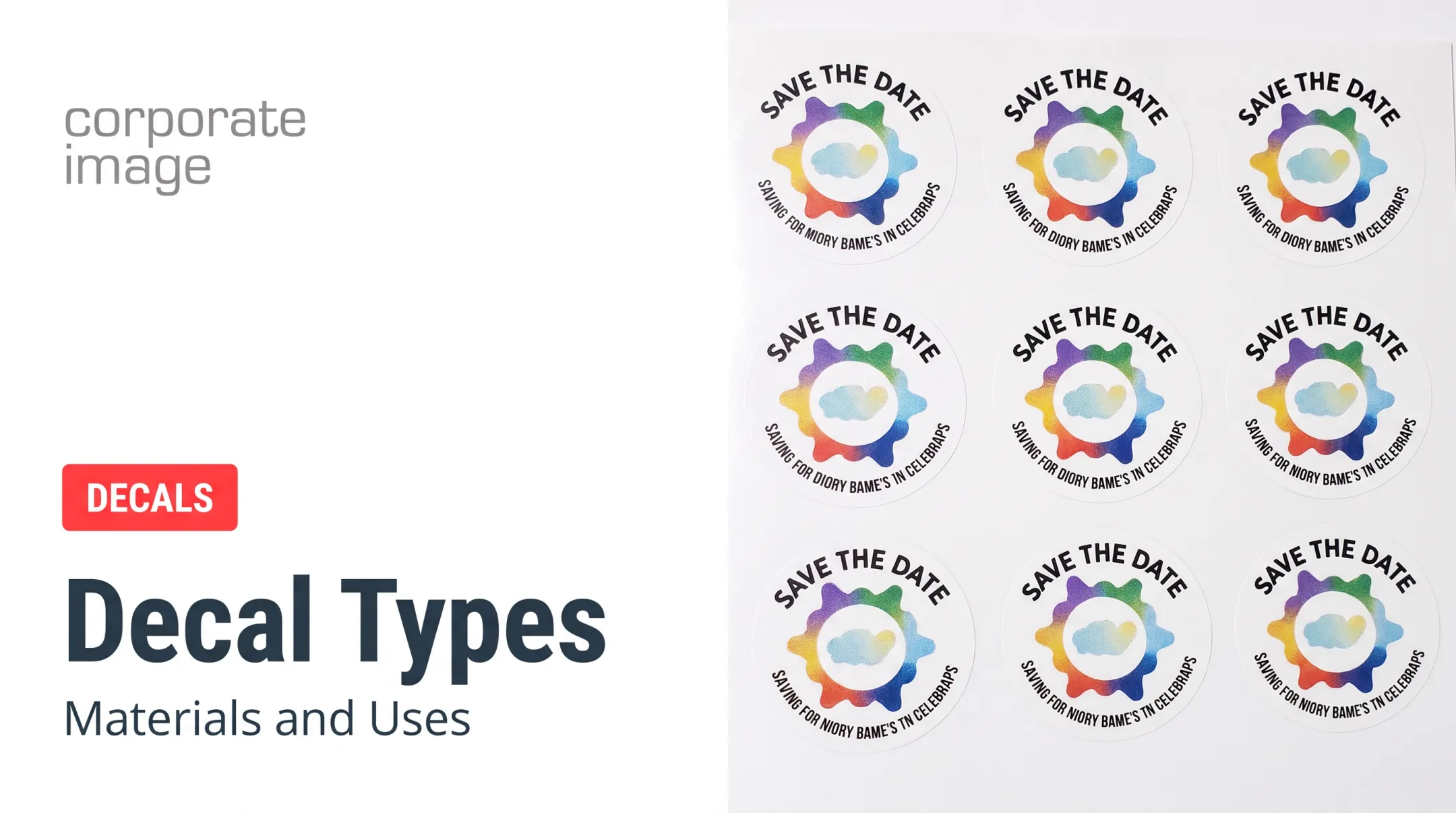
A kiss-cut decal is cut through the decal layer only, so the design stays attached to a larger sheet or border.
Operational benefits:
- Easier peeling
- Better protection in storage and shipping
- Organized handling when multiple designs travel together
Typical uses:
- Decal sheets and multi-location brand kits
- Instructional or equipment graphics
- Promotional distributions
- Projects with repeated hand application
Making a clean kiss cut takes calibration. Zund describes adjustable cutting pressure as essential for cutting vinyl and film without damaging the liner. Proof intricate artwork before approving a full run.

Die-Cut vs. Kiss-Cut Decals: Which Is Better for Your Application?
There's no universal winner. Decide based on how the decal will be stored, distributed, peeled, positioned, applied, and exposed.
Choose die-cut when:
- Pieces must be individually separated
- A clean contour presentation matters
- Decals go into handouts or packaging
- Extra backing would look distracting
Choose kiss-cut when:
- A larger backing makes peeling easier
- Decals need protection in transit
- Several designs share one sheet
- Staff or customers will apply them repeatedly
Match the environment separately
Pick the cut style, then specify material, adhesive, laminate, and installation method on their own. Durability ratings describe the film and exposure conditions, not the cut style.
ORAFOL lists ORACAL 751C at up to 8 years for black and white under vertical exposure in Climate Zone 1, with a 46°F minimum application temperature.
Surface prep matters as much as material choice:
- Painted vehicles: cure fresh paint fully
- Glass: remove wax or coatings before cleaning with 70% isopropyl alcohol and 30% water
- Textured surfaces and low-energy plastics such as polypropylene and polyethylene: test adhesion on the actual surface
Weigh project logistics
Consider quantity, packaging, shipping, storage, installation labor, artwork complexity, schedule, and total cost. If the cut format could change handling, request a sample or proof first.
Corporate Image produces custom decals and labels with 3M materials and offers design, production, and installation by 3M-certified installers. For a larger graphics project, ask the team to review your artwork and application requirements and coordinate materials, production, and installation. Confirm the exact cut options available for your job before you order.
Real-World Examples and Application Scenarios
Here are common scenarios where each cut tends to fit.
- Multi-site rollout: A brand sending equipment decals to many locations benefits from kiss-cut sheets. Backing protects pieces in shipping, and local crews peel them easily.
- Contoured logo on a fleet: A shaped emblem installed by a trained crew suits die-cut. Each piece is separate and ready to place.
- Reflective vinyl: Reflective decals can be cut to any custom shape, which suits contoured safety or branding marks.
- Equipment labels: Caution, warning, and model-designation decals on machinery benefit from a durable film and adhesive, whichever cut ships them.
Start with who applies the decal, where, and how many. Then pick the cut.

Corporate Image has served transportation, municipal, industrial, and resort customers for over 30 years. Request an estimate to discuss custom decal design, production, material selection, and installation.
Conclusion
Die-cut decals deliver an individually separated, contour-shaped look. Kiss-cut decals keep the backing intact for easier peeling and more controlled handling.
Before you choose, weigh these factors:
- Environment and surface conditions
- Material and adhesive
- Artwork complexity
- Distribution process and installation method
Demanding or multi-surface projects benefit from a professional review to avoid rework.
Frequently Asked Questions
How are kiss-cut stickers made?
A blade cuts through the printed decal layer but stops before the backing. Pressure and depth must be calibrated so the sticker peels cleanly.
What is the difference between die-cut stickers and kiss-cut stickers?
Die-cut stickers are cut through both sticker and backing. Kiss-cut stickers are cut through the sticker layer only and stay on the backing sheet.
Is a decal the same thing as a sticker?
The terms are often interchangeable. "Decal" commonly means a graphic applied to a surface, while "sticker" is broader. Material and adhesive determine suitability.
What type of paper is best for stickers?
Paper works for short-term indoor use. Vinyl or another durable film suits moisture, abrasion, vehicles, windows, equipment, and outdoor exposure. Choose by application.
Which is better for outdoor decals: die-cut or kiss-cut?
Either works outdoors with outdoor-rated material, adhesive, laminate, and proper surface prep. Choose by handling and installation needs, not weather resistance.
Are die-cut and kiss-cut decals equally durable?
Durability depends on material, print method, laminate, adhesive, exposure, surface condition, and installation. The cut mainly changes how the decal is supplied and handled.