Introduction
Customers, employees, visitors, and drivers meet your physical brand before they speak to anyone. A storefront, a truck passing on the highway, a lobby wall: each one says something about you.
Weak or inconsistent signs cost you that first impression. Corporate Image calls a company's image its "silent salesman," and signage does much of that selling.
Custom branding signage means purpose-built signs, graphics, decals, banners, wraps, labels, and environmental branding that express a company's identity while informing or guiding people.
In a FedEx Office survey, 76% of respondents said they had entered an unfamiliar store because of its signs.
This article covers signage formats, design principles, material choices, the project process, and the questions to ask before you invest.
Key Takeaways
- Custom signage turns your logo, colors, and typography into a consistent physical experience.
- The best sign balances brand expression with readability, surface, regulations, and weather.
- A coordinated system beats isolated signs across storefronts, fleets, and locations.
- One provider handling design, production, and installation reduces handoffs and errors.
What Is Custom Branding Signage, and Why Does It Matter?
What custom branding signage includes
Generic signs are bought off a shelf. Custom signs are shaped around your identity, location, audience, message, dimensions, materials, and installation conditions.
Common examples:
- Storefront signs and dimensional lettering
- Lobby signs, wall graphics, and window graphics
- Vehicle wraps and banners
- Wayfinding signs
- Equipment decals and safety labels
- Building graphics
Why signage is a brand asset
Signs shape first impressions, recognition, and perceived professionalism.
Sign Research Foundation findings from Cincinnati studies put the four-year average at 54% of consumers failing to find a business because of small or unclear signs. Another 38.5% made quality assumptions from clear, attractive signs.
These are self-reported perceptions, not proof of sales lift. Still, they show how easily a poor sign costs you attention.

Branding versus promotional, informational, and safety signage
Each sign type has a job:
- Branding: builds long-term identity and recognition
- Promotional: pushes a temporary offer or event
- Informational: communicates details
- Wayfinding: directs movement
- Safety: supports compliance and hazard communication
One project often blends several. A gas station canopy, for instance, can carry permanent brand colors and a "FREE GAS" promotion at once. The shared visual system keeps it coherent.
How environment changes priorities
- Retail and restaurants: attract foot traffic from the street
- Offices and commercial properties: guide visitors and signal professionalism
- Fleets: brand mobile assets
- Manufacturers: label machinery with durable, legible marks
- Ski resorts and large outdoor sites: help people navigate in harsh weather
- Government and public safety: require durable, compliant graphics
Define project goals first
Before choosing a format or material, write down:
- Objective and desired action
- Audience and viewing distance
- Location and lifespan
- Core message
Then set a measurable goal, such as better location visibility, simpler visitor flow, a standardized multi-site rollout, support for a rebrand, or a more professional fleet.
Types of Custom Branding Signage for Business Environments
Exterior, storefront, and building signage
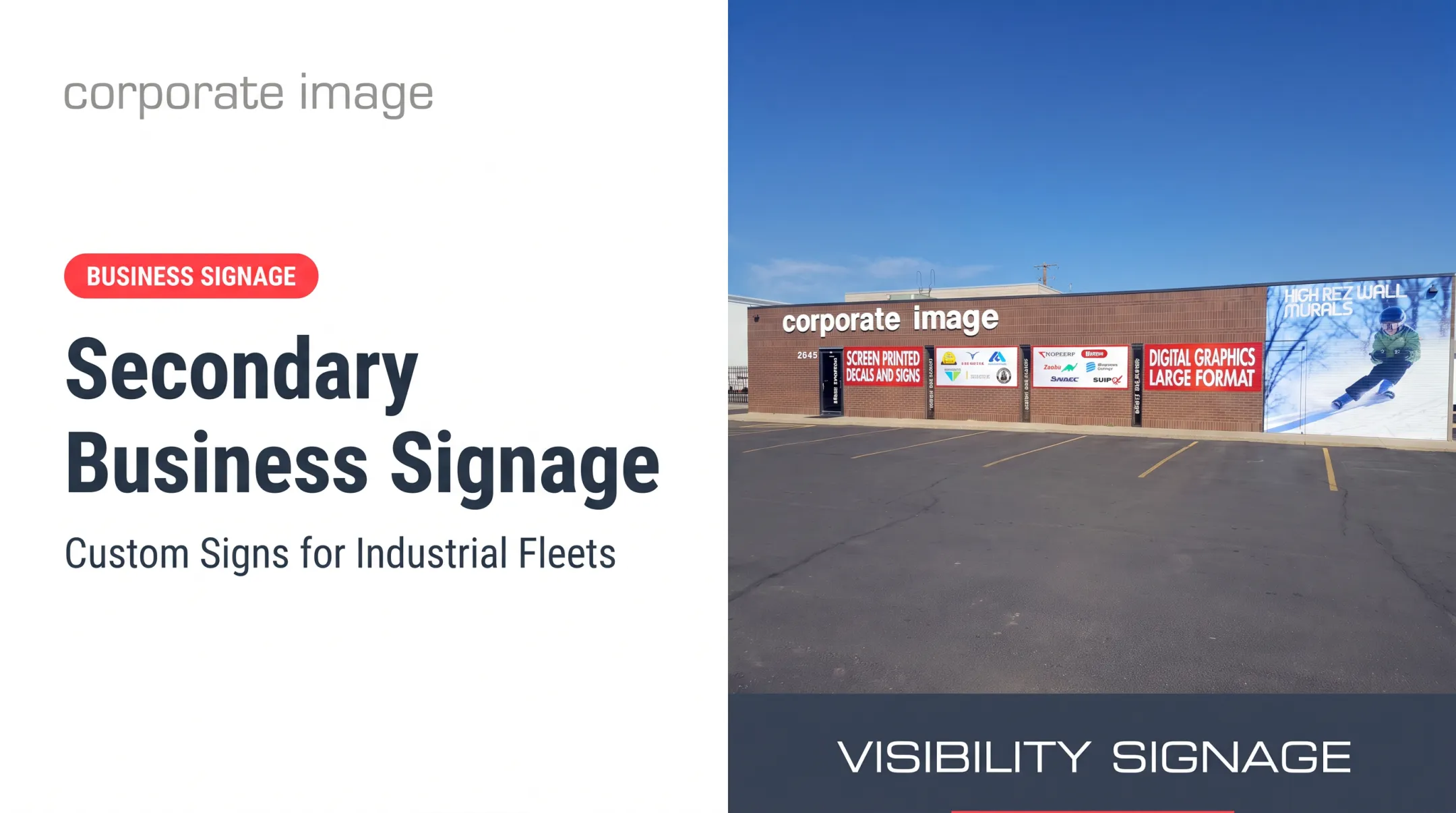
Channel letters are three-dimensional letters that can be lit for night visibility. Monument signs sit low to the ground at entrances and campuses. Pair those with building graphics, window graphics, and exterior banners, and you have the core toolkit for identifying a business from the street.
Viewing distance, traffic speed, lighting, architecture, local codes, and weather should drive scale, contrast, and placement. Many cities require permits. San Diego's Information Bulletin 111, for example, covers installation or alteration, with exceptions for copy-only changes.
Interior and environmental branding
Lobby signs, reception graphics, murals, values displays, floor graphics, and window films shape the visitor experience and reinforce culture. One office wall graphic pairs the message "Making Lives Better... One Interaction at a Time" with three panels: Passion, Performance, and Possibilities. Floor graphics need films rated for the surface, since heavy ink coverage can reduce slip resistance.
Wayfinding and informational signage
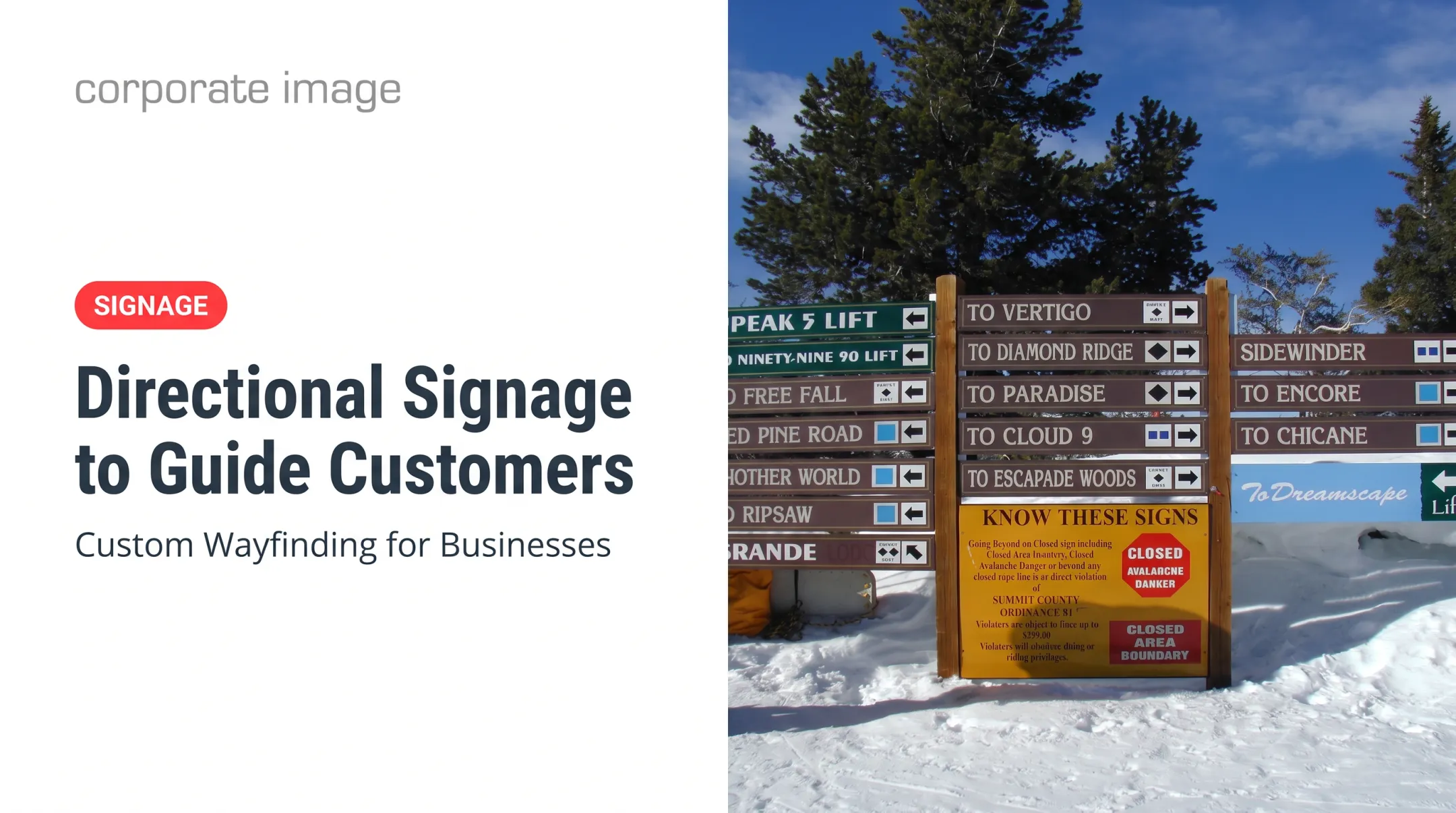
Directional signs, room IDs, aisle markers, and parking signs can carry brand colors, type, and icons without sacrificing clarity. Build a hierarchy: primary directions first, secondary details quieter. A ski resort directional sign shows this well, pointing guests to runs with arrows and trail symbols plus a small panel for today's grooming status.
Vehicle graphics and fleet wraps
Branded vehicles take your identity beyond one address. Nielsen's 2019 wrapped media study found 64% of respondents noticed wrapped vehicles monthly. That measures notice, not daily impressions.
Plan for:
- Vehicle contours and viewing angles
- Door handles and hardware placement
- Driver visibility
- Future removal or replacement
- Consistent application across different models
Equipment decals, industrial labels, and specialized graphics
Manufacturers need decals, control-panel graphics, safety labels, and machine markings that carry the brand and survive abuse. Spec each job against:
- Substrate compatibility
- Abrasion, chemicals, and heat
- Cleaning routines and compliance rules
- Order quantities
Screen printing matters in these settings. It lays down roughly 200 microns of ink versus about 10 for digital, which is why Corporate Image relies on it for demanding industrial work.
Promotional, event, resort, and temporary signage
Banners, event graphics, seasonal displays, sponsor graphics, construction graphics, and lift or mountain branding often need fast updates. Stay on-brand with modular parts and replaceable panels, keeping logo, color, and type fixed while the message changes.
Design Principles for Effective Branded Signage
Build a recognizable visual system
Translate your logo, colors, typography, imagery, icons, and spacing into signage rules. Then document them in a signage standards guide covering:
- Approved colors and typefaces
- Logo clear space and minimum sizes
- Artwork file formats
- Variations for different surfaces
Prioritize readability and visibility
The U.S. Sign Council's on-premise guidelines set roughly 30 feet of viewing distance per inch of capital-letter height, adjusted to 25 or 20 in congested settings. They also recommend 4 to 8 words, readable in roughly four seconds.
A practical test: a script font, pale gray on white, with 25 words of copy fails at highway speed. Bold sans-serif, high contrast, and six words wins. Poor lighting or a busy background can undo even good design.

Match materials and finishes to the environment
Substrate, ink, laminate, adhesive, and mounting depend on exposure. Manufacturer ratings carry qualifiers.
ORAFOL's warranty, for example, reduces rated life by climate zone and orientation, and surfaces more than 10 degrees off vertical count as horizontal. Ask for the data sheet for your actual conditions rather than trusting a universal claim.
Create message hierarchy
Layer content so each sign carries only what its audience needs at that spot:
- Brand identifier
- Primary message
- Supporting information
- Call to action
- Legal or safety details
Point readers to a website or staffed desk for everything else.
Plan for accessibility, compliance, and maintenance
ADA rules require tactile characters and Braille on permanent room identification, but company names and logos are exempt.
- Raised characters need at least 1/32 inch relief
- Tactile signs mount 48 to 60 inches above the floor
- OSHA 1910.145 and ANSI Z535 govern safety signs
- Check zoning and permits early
Plan upkeep before production too. 3M advises non-abrasive cleaners and hand washing, with vinyl signs cleaned at least yearly.
How to Plan, Produce, Install, and Maintain Custom Branding Signage
Start with a project brief and site assessment
Capture the project essentials up front:
- Brand objectives and target audience
- Locations, sign types, and dimensions
- Surfaces, viewing conditions, and access
- Schedule, budget range, and required approvals
Verify measurements on site before final artwork, especially for walls, windows, vehicles, and machinery.
Use a controlled design and proofing process
- Review scaled artwork against verified site measurements
- Approve color and material samples under real lighting conditions
- Check placement mockups for sightlines, fit, and clearance
- Proofread every word on every graphic
- Confirm installation methods and structural details
- Sign off in writing before production begins
For multi-site rollouts, keep a master artwork package, version control, and a documented approval chain. FASTSIGNS' Red Dot Storage case shows the scale: acquired facilities across 11 Midwest states were standardized with gate signs, door decals, and wall graphics.

Choose an experienced production and installation partner
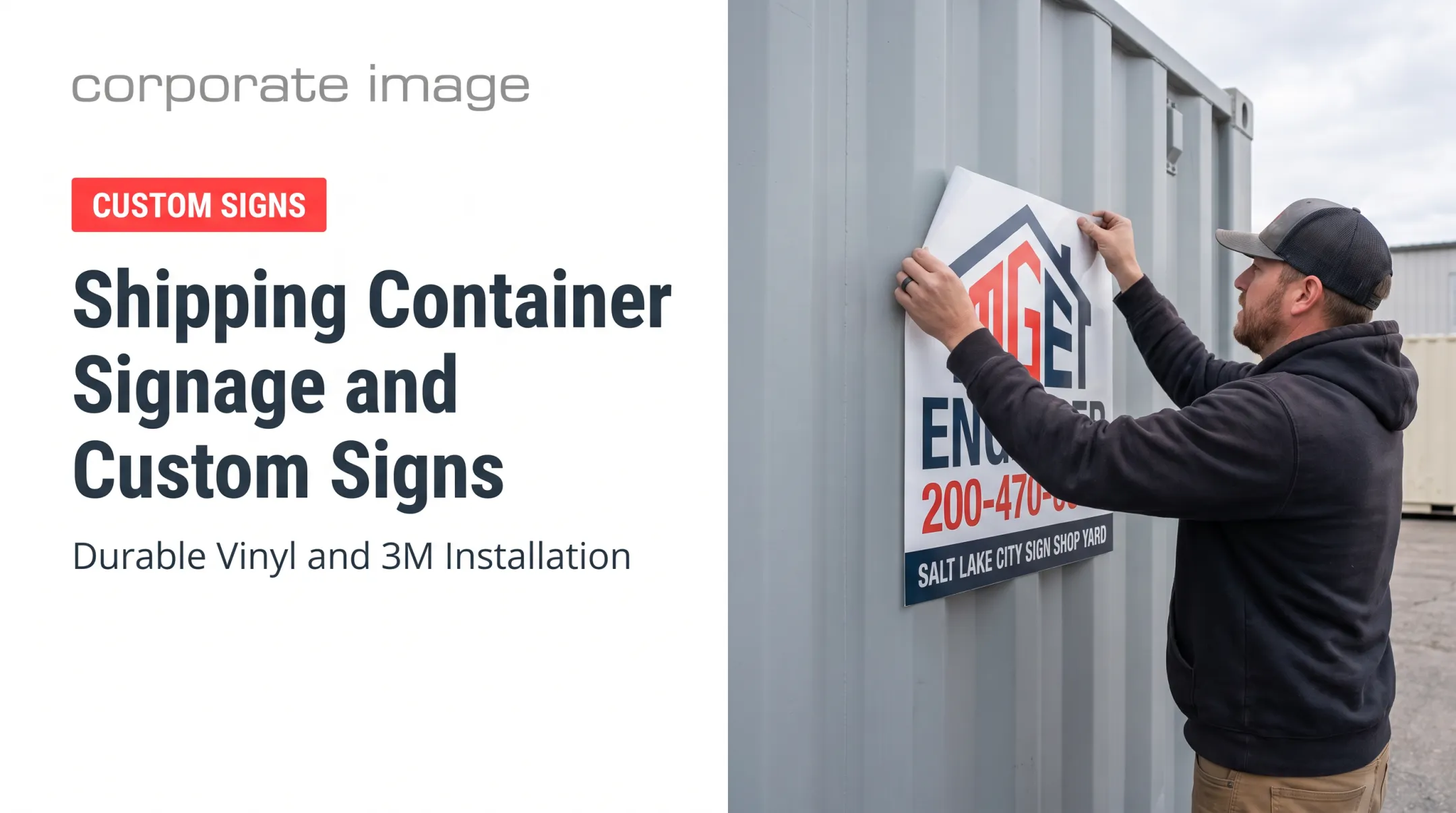
Corporate Image, based in Salt Lake City, is a full-service graphics, signage, printing, and installation provider with over 30 years of experience. The team handles jobs from concept to finish on vehicles, windows, walls, floors, buildings, and machinery, including specialized 3M materials for porous and low-adhesion surfaces.
Corporate Image holds 3M Certified Graphics Installation Company and 3M Preferred Graphics Installer credentials. It serves Utah and the Intermountain region, including ski resorts, and evaluates projects outside that footprint case by case.
Protect the investment after installation
At handoff, request:
- Cleaning instructions and maintenance responsibilities
- Replacement specifications and warranty terms
- A record of approved artwork and materials
Review signs periodically for fading, peeling, damage, outdated messaging, lighting problems, and changes to brand standards or regulations.
Frequently Asked Questions
What is promotional signage?
Promotional signage highlights an offer, product, event, or time-sensitive message. Branding signage builds long-term recognition. Both can share the same colors, fonts, and logo.
What are the 7 stages of the branding process?
Seven-stage models vary. Adobe's rebranding workflow runs: define the opportunity, research the landscape, set strategy, design the identity system, protect what works, plan the rollout, and measure and maintain. Signage lands in the rollout stage.
How much does custom branding signage cost?
Cost depends on sign type, size, materials, artwork, quantity, surface prep, lighting, permits, access, and installation. One Tucson shop has published truck graphics pricing of $225 to $290 for basic work and $3,100 for a full wrap. Treat that as a rough benchmark and request a project-specific quote.
What materials are best for custom branding signage?
Match the material to surface, exposure, and lifespan. Cast vinyl suits curved vehicle surfaces, window films suit glass, screen-printed decals suit equipment, and molded fiberglass or poly suits outdoor trails.
How can a business keep branding consistent across multiple locations?
Use a signage standards guide, an approved artwork library, color and material specs, location templates, centralized approvals, and a qualified installer at every site.