Introduction
Decals are adhesive graphics that identify, decorate, inform, direct, or promote. They show up on vehicles, windows, walls, floors, equipment, and buildings. The problem is that two decals can look identical on a proof and perform very differently in the field.
Material, adhesive, and finish decide whether a graphic stays put, stays readable, and comes off cleanly. A wrong match means peeling, bubbling, fading, or a costly early replacement.
When a decal holds up, that visibility turns into real exposure. In a 2019 survey, Nielsen's OOH study found 64% of respondents noticed vehicle advertising in the past month.
This guide compares the main decal materials, covers common business uses, clears up decal-versus-sticker terminology, and gives you a practical selection framework.
Key Takeaways
- Material, adhesive, finish, and surface all affect decal performance, not looks alone.
- Standard vinyl is versatile; specialty films solve privacy, one-way vision, and night visibility.
- Static clings and removable vinyl suit temporary or frequently changing graphics.
- Surface, exposure, service life, and removal needs should drive the choice.
What Are Decals and Why Do They Matter?
What Is a Decal?
A decal is a printed, cut, or transferred graphic made to adhere to another surface. It uses an adhesive backing, a transfer layer, or a low-tack attachment method. Common formats include:
- Lettering and logos
- Labels and safety graphics
- Window films and floor graphics
- Vehicle graphics and large-format branding
What Is a Decal vs. a Sticker?
In commercial graphics, the two words overlap heavily. Merriam-Webster describes a decal as a design transferred from specially prepared paper, and a sticker as a slip with an adhesive back. Vendors often call one-piece products decals too, so transfer tape is a format distinction, not a universal rule.
Neither word tells you about durability, removability, or quality. Those come from the material, adhesive, ink, laminate, and installation.
Why Do Decals Matter for Businesses?
Businesses rely on decals for:
- Consistent branding and fleet identification
- Wayfinding and safety communication
- Privacy coverage and temporary promotions
Those graphics go on windows, walls, floors, equipment, and vehicles. Corporate Image, a Salt Lake City graphics producer, builds decals for each of those surfaces in industrial, fleet, retail, and resort settings.
Poor matching causes real damage:
- Peeling and edge curl
- Bubbling from outgassing or uncured paint
- Fading and poor readability
- Difficult removal or surface damage
3M's bulletins warn that incompletely cured ink can cause curling, extra shrinkage, and adhesion failure. Production details matter as much as the film.

Types of Decals
Decal types differ by substrate, adhesive behavior, visual function, installation method, and environment. Finish and shape are usually options layered on a material, not separate material types.
Type 1: Standard Adhesive Vinyl Decals
This is a printed or cut vinyl graphic with a pressure-sensitive adhesive. The key split is how the film is made:
- Calendered vinyl is rolled through heated rollers. It suits flat or moderately simple surfaces.
- Cast vinyl is cast from a solvent mixture, leaving low internal tension. It is flexible with little shrinkage, which helps on curves and demanding vehicle work.
Common uses: storefront windows, walls, floors, vehicle bodies, fleet graphics, machinery, indoor branding, and general signage.
Strengths: broad color and shape options, contour cutting, and fit for short or long projects when the right grade is chosen.
Trade-offs: adhesive and grade must match surface texture, curves, exposure, cleaning, temperature, and removal plans. Published life belongs to a specific product, color, and climate.
For example, ORACAL 651 (calendered) lists 6 years for most colors in a vertical, Climate Zone 1 exposure, while ORACAL 951 (cast) lists 8 to 10 years under the same conditions. Both list a 46°F minimum application temperature. Always check the current spec sheet rather than trusting one universal lifespan.

Type 2: Specialty Performance and Decorative Film Decals
Specialty films are best grouped by the problem they solve.
| Goal | Film | Notes |
|---|---|---|
| One-way vision | Perforated window film | 3M IJ67 has 40% perforation; 1-year expected performance unprotected |
| Night and attention visibility | Reflective, fluorescent | ORACAL 6510 fluorescent lists 1 to 2 years unprinted outdoors |
| Privacy and decoration | Frosted or etched | ORACAL 8510 lists 7/5/3 years by climate zone |
| Visual effect | Metallic, carbon-fiber, brushed metal | Directional textures; hand wash only |
Uses include storefront and vehicle windows, office partitions, wayfinding, nighttime recognition, and premium brand accents. Corporate Image offers reflective vinyl cut to custom shapes for law-enforcement and industrial vehicles, hard-hat decals, and hazard markings.
Each trade-off is real. Perforated film gives up some clarity and natural light for graphics. Textured films look striking but need gentler cleaning. 3M advises against washing wrap film for the first 72 hours.
Reflective needs differ too. Traffic-sign sheeting such as 3M 3930 meets ASTM D4956 Types III and IV, but that is a sign-specific standard, not a claim for every reflective decal. Confirm printing, lamination, application, and compliance requirements before ordering.
One more legal note: federal rule 49 CFR 393.60 limits stickers on commercial vehicle windshields. That rule does not grant blanket permission for advertising on any vehicle window.
Type 3: Temporary, Removable, and Repositionable Decals
These suit seasonal messages, rented spaces, events, temporary wayfinding, and rotating promotions.
- Static clings use no adhesive. Nekoosa's Hi-Stat lists 2 years indoors and 3 months outdoors, with a 50°F minimum application temperature.
- Removable vinyl widens the surface range. 3M IJ8150 clear film is rated for removal without heat from most substrates within its warranty period, but 3M makes no promise about speed or ease.
- Repositionable adhesive such as 3M IJ180mC lowers initial tack so installers can adjust placement. That is an installation feature, not a reuse guarantee.
Clings work best on clean, smooth glass. To remove one, lift an edge and pull it smoothly off the glass.
The trade-off: less resistance to weather, heat, moisture, handling, and long-term exposure than permanent outdoor-grade materials.
Decal Formats, Finishes, and Production Choices
These choices change appearance and application without creating a new material category.
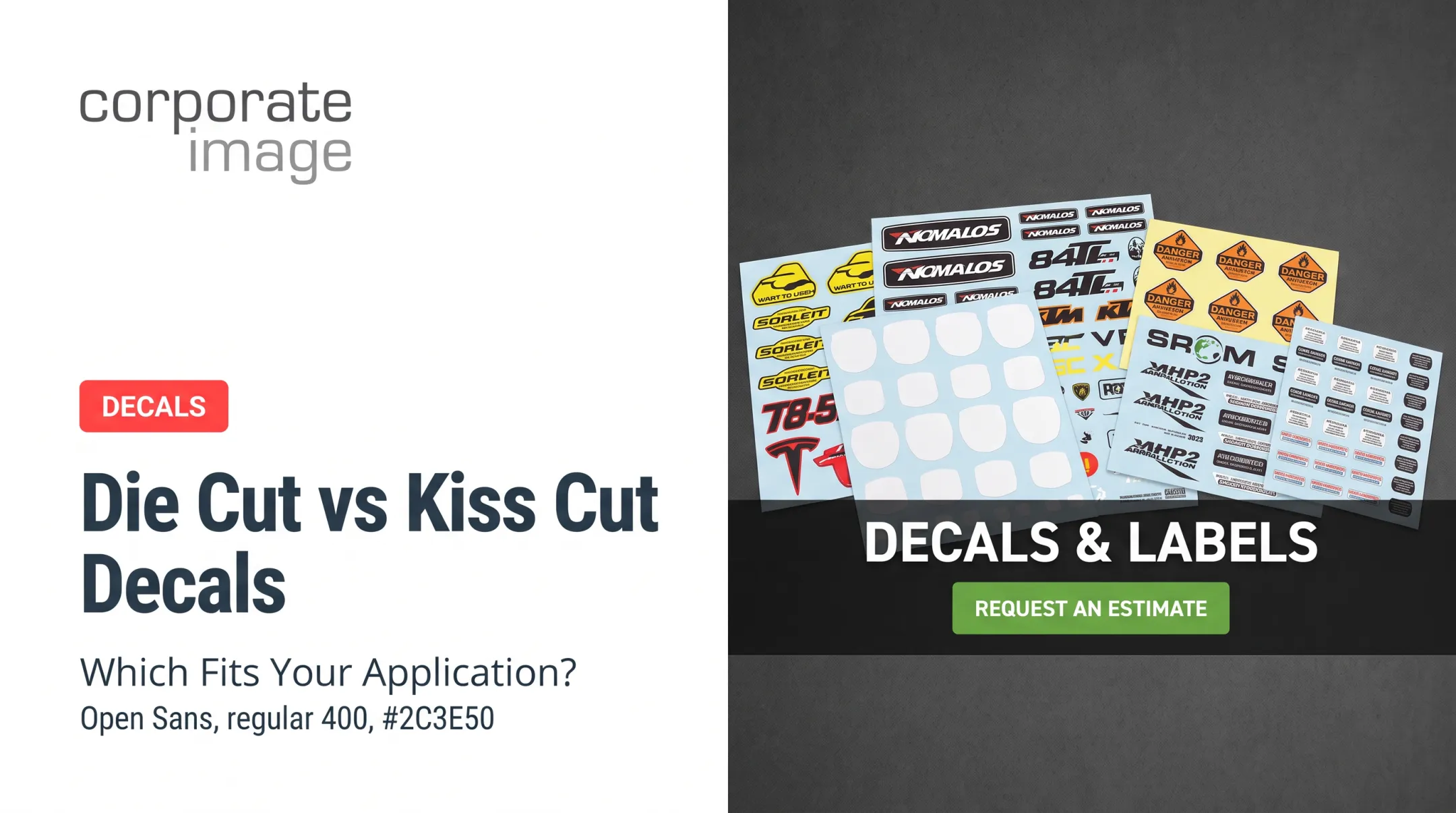
- Cutting: die-cut pieces ship individually; kiss-cut leaves the backing intact; transfer-cut graphics use application tape to hold separate elements in alignment.
- Finishes: 3M overlaminates come in gloss, luster, matte, and ultra-matte. Laminates add UV, abrasion, and chemical protection.
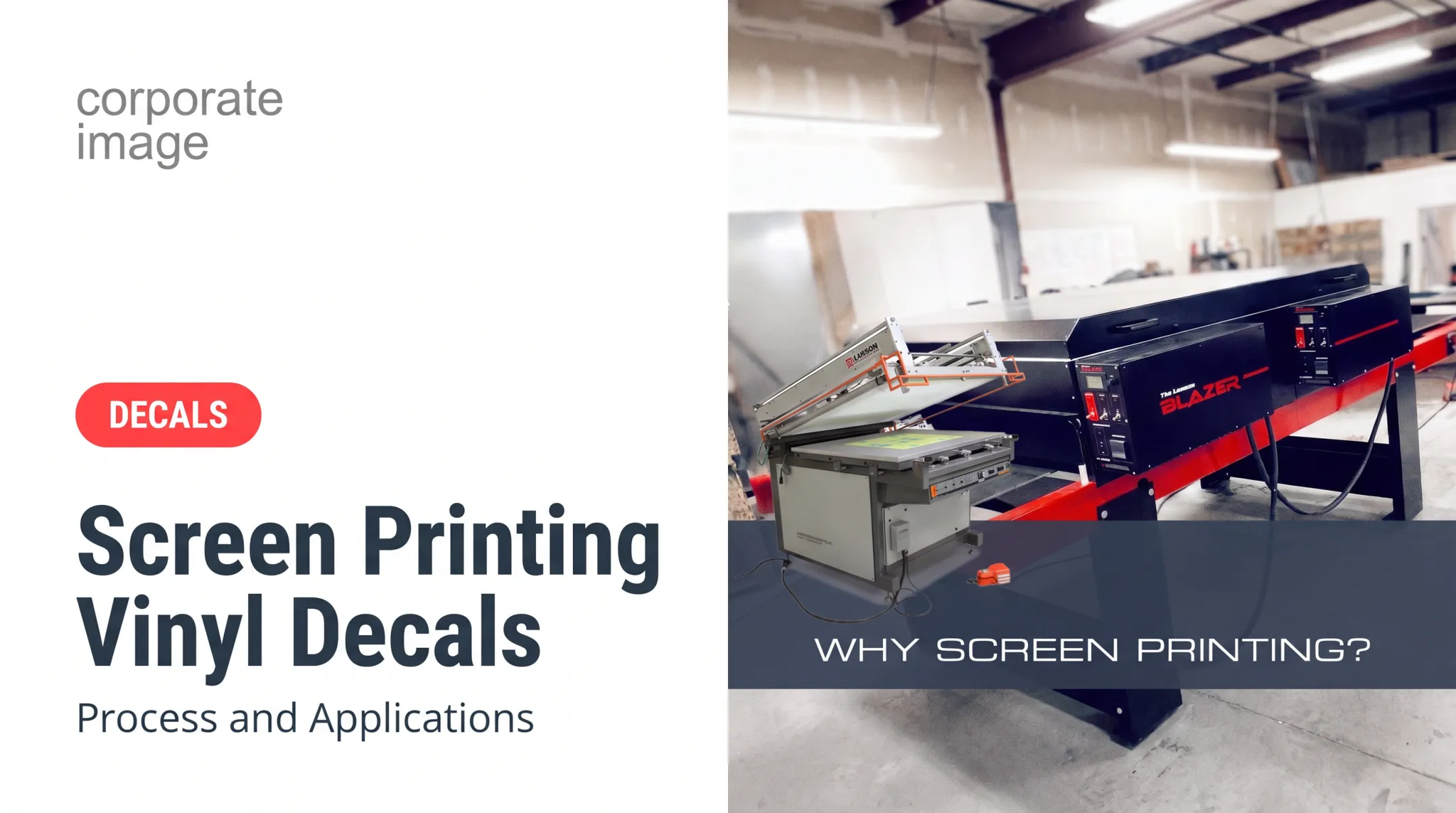
- Printing: screen printing offers hand-mixed color matches and heavy ink deposit; digital suits custom runs and variable data.
Corporate Image says screen printing lays down about 200 microns of ink against 10 for digital. For screen-printed work, a liquid UV clear coat is the protective layer; digital prints typically get an adhesive laminate.
Separate taste from need. A glossy or clear finish should never cost you legibility, adhesion, or safety. ISA guidance suggests at least 1 inch of letter height per 25 feet of viewing distance.
How to Choose the Right Type of Decal
Match the decal to the project's purpose and conditions. Fancy or expensive film is not automatically the right choice. Work through these factors:
- Purpose and message: branding, safety, privacy, wayfinding, or a short promotion each prioritize different features.
- Surface and condition: glass, painted metal, plastic, concrete, flooring, or machinery. Check texture, curvature, coatings, contamination, moisture, and old graphics. Low-energy plastics and textured paint are common problem surfaces.
- Exposure and service life: indoor or outdoor, UV, rain, snow, abrasion, chemicals, temperature swings, cleaning. Ask for product-specific performance data before accepting durability claims.
- Visibility and design: distance readability, night visibility, view-through glass, brand color match. Match opacity, contrast, and finish to viewing conditions.
- Budget, scale, and installation: quantity, size, access, downtime, future replacement, and removal. Large quantity orders are typically more cost-effective.

For projects spanning vehicles, windows, walls, floors, or machinery, an experienced partner reduces coordination and installation risk.
Corporate Image provides design, production, and professional installation under one roof, with 3M materials and 3M-certified installers. Credentials differ in scope: 3M Preferred recognizes an individual installer, while Certified Graphics Installation Company recognizes a business after an on-site audit.
What to Check Before Finalising a Decal Type
What to Check Before Finalizing a Decal Type
Run through this list before approving a spec:
- Don't buy on color, finish, or price alone. Confirm adhesive, film, laminate, and installation method fit the real surface and exposure.
- Prepare the surface. 3M says substrates should be clean, dry, and nonporous. Roughness beyond a 150-grit sandpaper reference makes adhesive contact harder.
- Check temperature and cure time. Application minimums run from 46°F to 50°F for the films above. Uncured paint or ink causes failure.
- Verify cleaning compatibility. Hi-Stat resists commercial window cleaners but not strong organic solvents. Test cleaners and wipe fuel spills promptly.
- Read the fine print. "Permanent," "removable," "outdoor," and "weather-resistant" vary by product. Review manufacturer specs, artwork requirements, maintenance and removal guidance, and any safety or regulatory rules.
Conclusion
Decals are flexible graphics for branding, communication, privacy, identification, decoration, and wayfinding across commercial and industrial surfaces. Standard vinyl, specialty films, and temporary options each solve different problems, while finishes, formats, adhesives, and printing methods shape the result.
Before you choose, evaluate the surface, environment, service life, visibility, installation, and removal requirements. Then get the manufacturer's spec for the exact product.
Frequently Asked Questions
What are the different types of decals?
The main groups are standard adhesive vinyl (fleet graphics), specialty films such as perforated or frosted (storefront windows), and temporary options such as static clings or removable vinyl (seasonal promotions).
What is a decal vs. a sticker?
The terms are often interchangeable. "Decal" can refer to a graphic transferred from a carrier sheet, while "sticker" suggests a one-piece adhesive graphic. Material and adhesive determine performance.
What are the different types of stickers?
Common categories include paper, vinyl, clear, die-cut, kiss-cut, removable, static cling, weather-resistant, and specialty-effect stickers. Terminology varies by supplier, so confirm the actual material.
Which decal material is best for outdoor use?
Outdoor-grade vinyl is the usual choice. The right pick depends on UV exposure, weather, surface, expected life, adhesive, laminate, and the manufacturer's specifications.
What type of decal is best for windows?
It depends on the goal. Choose clear or opaque vinyl for promotion, perforated film for one-way vision, frosted film for privacy, or static cling for temporary displays.
How do you choose between permanent and removable decals?
Permanent or long-term adhesive fits stable branding and identification. Removable or repositionable products suit seasonal campaigns, temporary spaces, and messages that change often.