Introduction
Industrial graphics rarely just decorate. They identify equipment, warn operators, guide visitors, carry a brand, and protect an investment in places where sun, solvents, and scuffing are routine.
A safety decal on a ladder rail, such as the "4 POINT CONTACT" and "ACT SAFELY" decal in Corporate Image's Savage project, only works if it stays legible and attached.
The procurement problem is that quotes arrive incomplete. One bid includes installation, another doesn't. One names the laminate, another says "durable." Site problems surface after production.
This checklist walks through what to define, what to ask suppliers, and how to compare proposals fairly.
Key Takeaways
- Define application, surface, environment, quantity, artwork, compliance and installation scope before requesting quotes.
- Judge suppliers on relevant experience, material knowledge, proofing and installation, not price alone.
- Compare total project cost, including prep, freight, installation, replacement and warranty.
- Get written approvals and site-specific material recommendations before production starts.
What Industrial Graphics Design Includes
Industrial graphics design is the planning and creation of applied visual graphics for equipment, machinery, facilities, fleets and products. The output is typically decals, labels, panels, wraps, signs and wayfinding.
Not the same as industrial design
The Industrial Designers Society of America defines industrial design as the professional design of products, devices, objects and services. That covers form, function and manufacturability. Industrial graphics are applied to products and spaces that already exist.
Where procurement teams encounter them
- Equipment decals, labels and machine identification
- Safety and warning graphics
- Fleet graphics and trailer wraps
- Outdoor signage and facility wayfinding
- Wall, floor and window graphics
- Multi-site brand rollouts
Corporate Image, a Salt Lake City supplier, shows how broad this gets: its gallery includes machinery wraps, locker and parking-kiosk wraps, building graphics and industrial warning labels.
Define the Project Before Requesting Quotes
A vague request produces vague quotes. Document these items first.
Purpose and audience
State what the graphic must do and who reads it: operators, maintenance crews, drivers, visitors or the public. A QR code on a parking kiosk has a different job than a hazard label.
Surface and environment
Record the substrate, dimensions, contours, indoor or outdoor exposure, sunlight, moisture, temperature swings, abrasion, chemicals and cleaning methods. This drives the choice of film, adhesive, laminate, ink and installation method.
Surfaces matter more than most buyers expect. 3M notes that moisture, oils and undercured paint can impair adhesion, and improper preparation voids applicable warranties. Low-surface-energy plastics and textured paint are common trouble spots.

Quantities, assets and deliverables
- Quantities, variations, locations and repeat orders
- Shipping destinations and packaging needs
- Vector artwork, logos, brand standards, color references and copy
- Barcodes, serial numbers and other variable data
- Required approvals: proofs, color samples, prototypes, installation drawings, final documentation
Large-quantity runs are where screen printing tends to pay off, so state volumes up front.
Compliance requirements
Different assets answer to different authorities. Confirm the responsible one for each:
- OSHA 29 CFR 1910.145 for workplace accident-prevention signs
- ANSI Z535 series for safety colors, signs and labels
- 2010 ADA Standards for room identification and directional signs
- MUTCD for traffic-control devices on public roads
- FMCSA 49 CFR 390.21 for covered commercial vehicle markings
Put the applicable requirement, edition and approving authority in the request, not just "compliant graphics."
Evaluate a Supplier's Design and Production Capabilities
Check the portfolio for comparable work
Attractive retail examples tell you little. Look for work similar in material, scale, environment, surface difficulty and finish.
Confirm the full workflow
Ask whether the supplier handles the full path:
- Design help and prepress
- Printing, finishing and fabrication
- Logistics, installation, removal and replacement
Then cover quality controls:
- Color management, file preparation and variable data
- Contour cutting, lamination and proofing
- Batch consistency and pre-shipment inspection
Also ask for the revision policy, approval responsibilities, escalation path, and how damaged or out-of-spec graphics get handled.
Separate the credentials
Credentials are not interchangeable. 3M describes distinct programs: a Certified Graphics Installation Company passes an on-site audit, while a Preferred Installer is an individual tested in named specialties. Warranty eligibility is a third item, tied to approved material constructions.
Likewise, G7 certification validates gray-balance control. It does not guarantee a brand-color match.
Corporate Image is one profile buyers can assess:
- Over 30 years in graphics
- Design-to-installation service
- 3M Certified Graphics Installation Company status
- Factory-direct 3M relationship
- SGIA and UASG memberships
Whatever the supplier, ask for insurance documentation and customer references directly.
Test reorder support
For multi-location programs, ask about:
- Retained artwork and documented specifications
- Consistent color and part numbering
- Inventory options
- How future changes get approved
Verify Materials, Durability and Compliance
Reject a generic "durable" line item. Require a recommendation tied to your actual use.
Ask for the exact material system
The quote should name:
- Film or substrate, adhesive and print method
- Protective layer, such as adhesive laminate or liquid UV clear coat
- Expected service conditions and surface-prep requirements
- Warranty limits and recommended maintenance
Print method changes durability. Corporate Image notes that screen printing deposits far more ink than digital and, on poly plastic, bites into the surface. Digital prints typically get an adhesive laminate, while screen-printed work gets a liquid clear coat.

Read published specs with their conditions
Published numbers are conditional. Avery's MPI 1105 data sheet lists up to 7 years of vertical durability and refers printed life to separate exposure documentation. That figure is not a promise against every industrial chemical.
Ask for manufacturer documentation covering:
- UV, moisture and abrasion resistance
- Chemicals, oils and cleaning agents
- Temperature range and impact
Check legibility and compliance details
Confirm:
- Contrast, typography, symbols and placement on safety and wayfinding graphics
- Barcode and QR readability, ideally verified rather than scanned once
- ADA requirements such as non-glare finishes and Braille duplication where applicable
Approve proofs for fit, not just looks
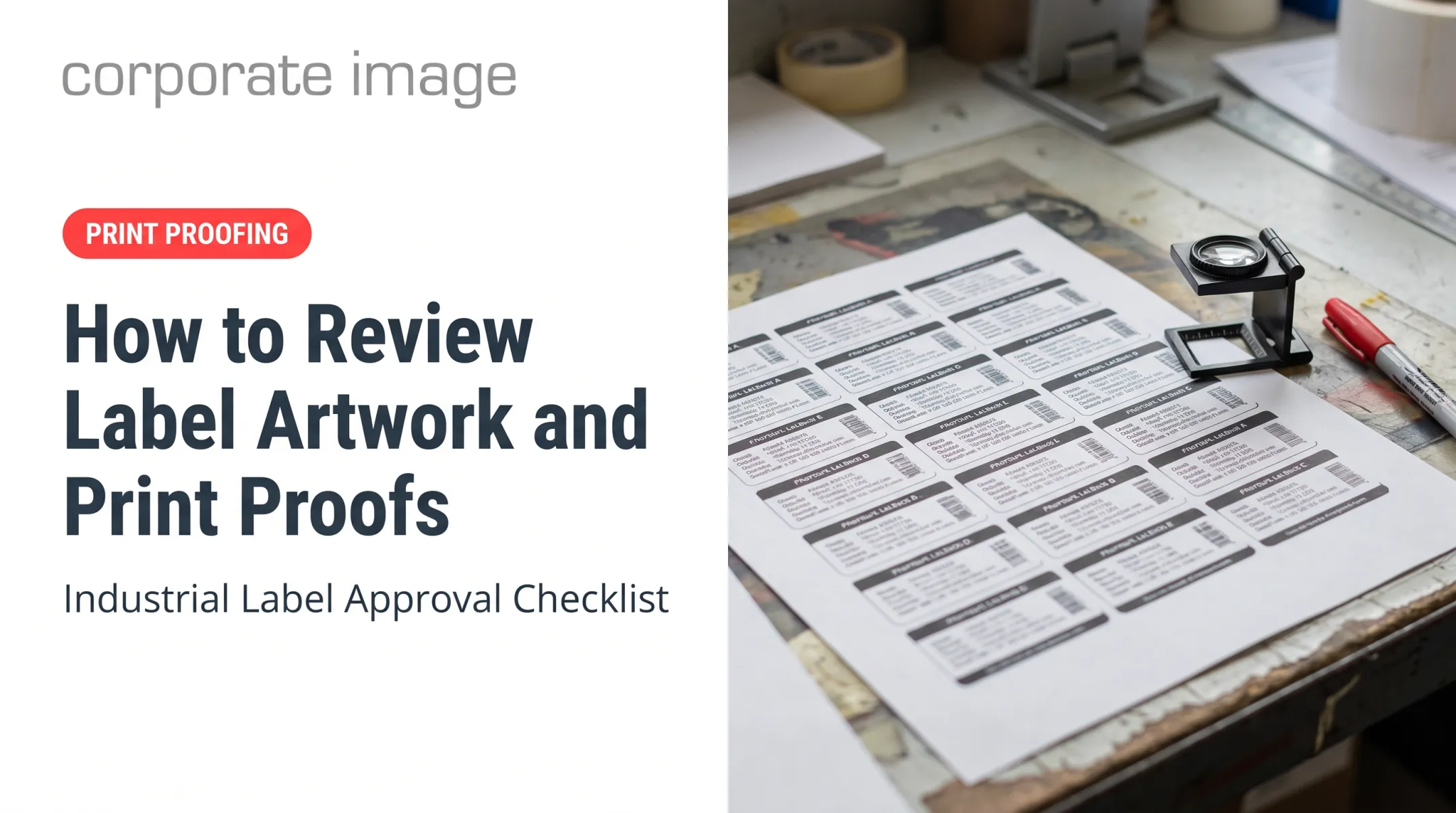
Require a physical or digital proof showing size, placement, color intent, copy, variable data and finishing. Procurement should sign off on technical suitability as well as visual accuracy.
Compare Quotes, Timelines and Installation Plans
Line up identical scope
Compare proposals line by line across every cost and task:
- Design, artwork prep and proofs
- Materials, printing, finishing and packaging
- Freight, site prep, removal and installation
- Travel, taxes and disposal
Flag every assumption and exclusion.
A public example shows how much sits outside printing. A Coast Guard window-branding bid covered 47 offices. The scope included surveys, removal at 41 locations, cleaning, installation, travel and lodging. Materials had to arrive at least 3 working days before each installation.
Build the schedule
Map artwork approval, material availability, production, inspection, shipping, site access, installation windows, surface prep or cure time, and contingency. Ask each vendor to name dependencies that could cause delays.

Treat installation as part of the purchase
Confirm:
- Installer qualifications
- Surface preparation and access equipment
- Safety procedures and protection of surrounding areas
- Cleanup, punch-list work and sign-off
- Warranty terms
- Who pays if site conditions differ from assumptions
Compare lifecycle value
The cheapest bid can cost more after replacement, downtime and rework. Weigh:
- Durability and cleaning requirements
- Replacement frequency and reorder ease
- Consistency across sites
- Cost of fixing specification or installation errors
Corporate Image doesn't publish pricing for industrial work; buyers can call 801-485-0103 or request an estimate online.
Frequently Asked Questions
What does industrial design involve?
Industrial design covers the appearance, function, usability, materials and manufacturability of physical products. Industrial graphics design is different: it applies identification and communication graphics to products, equipment, vehicles and spaces.
What are industrial graphics used for?
They include equipment decals, safety labels, machine graphics, fleet branding, facility signage, wayfinding, and window, wall and floor graphics in industrial or commercial settings.
How do I choose the right materials for industrial graphics?
Match materials to the surface, exposure, abrasion, chemicals, temperature, cleaning routine, installation method and required service life. Rely on documented, application-specific supplier guidance.
What should I look for in an industrial graphics supplier?
Look for comparable portfolio work, material expertise, proofing, quality control, qualified installers, clear communication, references, warranty terms and reorder support.
What should an industrial graphics RFP include?
Include purpose, dimensions, quantities, artwork, locations, surfaces, environmental conditions, materials, compliance requirements, installation scope, schedule, shipping, deliverables and the pricing format you want.
How can I compare industrial graphics quotes?
Hold scope and specifications identical, then review materials, prep, proofs, production, freight, installation, lead times, warranty, exclusions, maintenance and replacement costs over the full lifecycle.